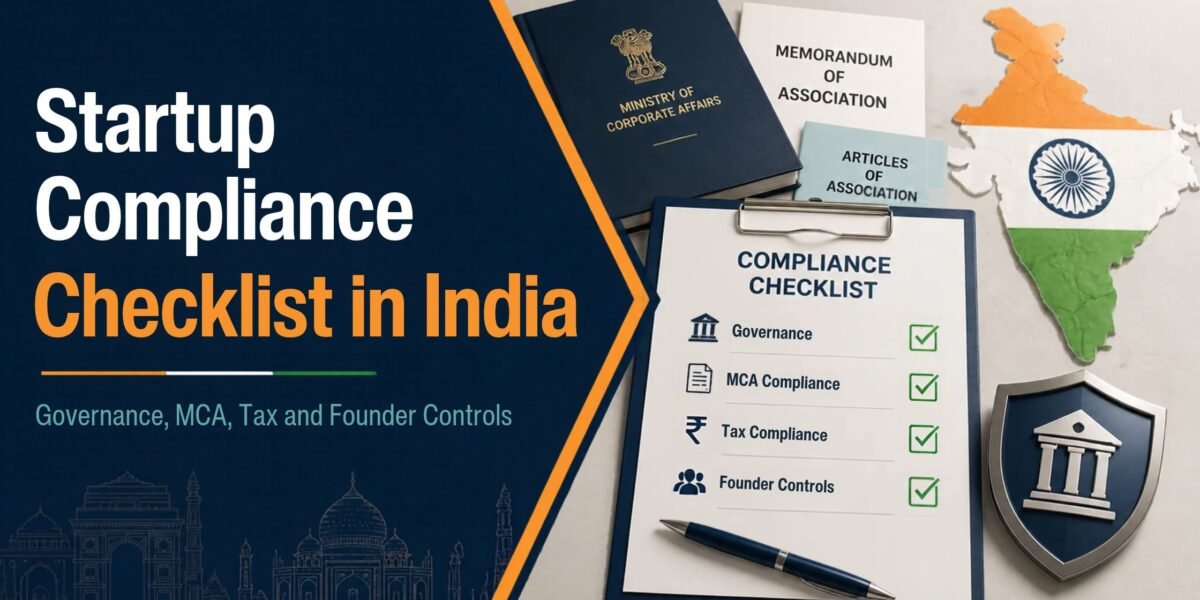
A comprehensive compliance roadmap for Indian startups, covering post-incorporation requirements, MCA governance, annual filings, tax and payroll obligations, cap-table management, ESOP preparedness, related-party transactions and DPIIT-related documentation.
Introduction: Startup Compliance Is Not Just a Filing List — It Is the Company’s Governance Framework
Many startups assume compliance becomes important only when they attract investors, generate substantial revenue or expand their finance teams. This approach can create risks. Compliance actually begins at incorporation and influences nearly every significant business activity, including opening bank accounts, issuing ESOPs, raising funds, appointing auditors, paying founders, entering into related-party transactions, maintaining cap tables and preparing for investor or acquisition due diligence.
The challenge is that early-stage businesses generally operate with limited resources. Founders concentrate on product development, recruitment and fundraising. Consequently, statutory obligations are often addressed only when required. Board meeting records may be prepared late, statutory registers may not be updated regularly, and tax filings may be managed as separate activities instead of being treated as part of a unified governance framework. These gaps may not cause immediate problems, but they can create complications when the company plans to raise funds, issue additional shares, grant ESOPs or undergo investor due diligence.
A well-planned startup compliance checklist is therefore about more than avoiding penalties. It helps maintain proper legal records and corporate discipline. A clean compliance history makes it easier for a business to expand, secure investment and justify its decisions when required. For founders building a sustainable business, compliance should be considered an essential part of company development rather than an administrative burden.
1. Incorporation-Stage Compliance: What Must Be Established from Day One
After incorporation, a startup must complete several foundational compliance requirements. The company should keep its constitutional documents, Certificate of Incorporation, PAN, TAN, bank account details, statutory registers and internal records properly maintained. Directors must also have valid DIN and DSC wherever applicable, and the registered office documents should be kept up to date.
The company must also complete its initial post-incorporation obligations under the Companies Act. These include appointing the first auditor, maintaining books of account, issuing share certificates and properly recording the initial board resolutions. Founders sometimes delay these activities because they do not appear immediately necessary for daily operations. However, several future corporate actions depend on these initial requirements being completed correctly.
This is also the right time to establish clear responsibility for financial and compliance matters. Even if the startup does not employ a full-time CFO, a designated person should manage the compliance calendar, maintain document records and coordinate with the CA, CS or legal adviser. Compliance issues often occur not because the requirements are ignored intentionally, but because no individual has clear responsibility for managing them.
2. Board and Shareholder Governance: Where Startups Often Lose Discipline Too Early
Board governance is one of the first areas where young companies tend to become irregular. Meetings may take place informally, approvals may be shared through emails or messaging platforms, and minutes may be prepared at a later stage. While these practices may help with internal coordination, they do not establish proper corporate records. Startups should follow a consistent process for conducting board meetings, passing resolutions, maintaining minutes and obtaining shareholder approvals whenever necessary.
This becomes particularly important when the company issues additional shares, grants ESOPs, approves related-party transactions, borrows funds, changes bank mandates or authorizes fundraising documents. Investors and potential acquirers generally examine board and shareholder records carefully during due diligence.
The key is to establish proper governance from the beginning rather than waiting until a term sheet arrives. When a company postpones reviewing earlier approvals until a funding round, it may end up spending valuable time correcting documentation instead of concentrating on the transaction.
3. Annual MCA Compliance: Financial Statements, Annual Returns and Event-Based Filings
Every startup incorporated as a company must consider annual MCA filings a mandatory responsibility. These requirements include preparing and adopting financial statements, completing the annual return process and submitting the applicable forms to the Registrar of Companies. Apart from annual filings, event-based submissions are also required when changes occur in directors, registered office, share capital, share allotments, charges or other statutory matters.
The difficulty in managing startup compliance is not simply the number of forms involved, but how different requirements depend on one another. If accounting records are incomplete, board approvals are unavailable or the cap table has not been reconciled, annual filing becomes more time-consuming and prone to mistakes. Delays in event-based filings can also create complications during future fundraising activities.
A practical solution is to maintain a centralized company secretarial tracker. It should include annual and event-based filings, the board meeting calendar, statutory registers and applicable deadlines. Establishing this system early can significantly reduce the cost and effort of correcting records later.
4. Tax Compliance: Income Tax, TDS, GST and Payroll Must Work Together
Founders often manage company law and tax compliance separately. However, both are closely connected from a risk management perspective. Startups must review their income tax return obligations, advance tax requirements wherever applicable, TDS deduction and payment, TDS returns, GST registration and returns where required, and payroll-related tax deductions for founders and employees.
Special attention should be given to founder remuneration, reimbursements, consultant fees, ESOP-related payroll matters and vendor classification. Several tax disputes arise from basic procedural mistakes, including failure to deduct TDS, incorrect classification of vendor payments or insufficient documentation supporting reimbursements.
GST should also not be viewed merely as an operational responsibility. The nature of the startup’s business, whether it involves SaaS, consulting, interstate supplies, marketplace services or exports, can influence its registration and filing obligations. The applicable requirements depend on the business model and cannot be determined by turnover alone.
5. Startup India and Tax-Incentive Readiness: Eligibility and Documentation Both Matter
For eligible recognized startups, benefits and incentive frameworks such as DPIIT recognition, the profit-linked deduction under Section 80-IAC and startup-specific relief relating to Section 56(2)(viib) or ESOP taxation timelines can be valuable. Official Startup India resources continue to outline the eligibility requirements for Section 80-IAC and startup-specific provisions relating to Section 56. However, founders sometimes assume that obtaining recognition automatically makes the company eligible for every tax benefit. This is not the case.
Startup recognition and eligibility for tax exemptions are connected but separate matters. Companies should maintain supporting records relating to innovation, scalability, share allotments, financial statements and other applicable eligibility conditions. If a tax benefit is reviewed, a recognition certificate alone may not be sufficient. The startup should also have a properly maintained set of documents supporting its eligibility.
The important takeaway for founders is to avoid making claims about tax benefits to investors or employees until the company has verified the applicable conditions and maintained the necessary documentation.
6. Cap Table and Securities Compliance: Equity-Related Errors Can Become Costly
A significant number of startup compliance matters ultimately relate to the cap table. Share certificates, allotment records, share premium documentation, Section 62 approvals, PAS filings, ESOP grants, founder vesting arrangements and investor rights must all match a single, accurate ownership record. Any mismatch can make future fundraising more complicated.
This is particularly important for startups that have issued convertible instruments, SAFE-style instruments, founder shares carrying special rights or equity in multiple tranches at different valuations. The company should maintain a centralized securities folder containing all relevant approvals, allotment documents, valuation records, statutory registers and filings.
Neglecting securities compliance during the early years can make subsequent legal due diligence difficult. Investors generally examine not only the current ownership structure but also the records and transactions through which that structure was created.
7. Related-Party Transactions and Founder Discipline
Startups in their early stages often depend on founders and connected parties for office space, loans, advances, support services, reimbursements and short-term funding. Such arrangements may be commercially reasonable, but they still require proper related-party compliance. Transactions should be documented, approved by the appropriate authority and accurately recorded in the company’s books.
Related-party transactions are not prohibited simply because they involve founders or connected persons. However, arrangements that are undocumented or lack clear pricing can create governance concerns. They may affect the accuracy of financial statements, complicate due diligence and raise tax-related questions involving disallowances, transfers of value or insufficient supporting evidence.
Well-managed startups are not necessarily those that avoid every transaction involving founders or their associates. They are the ones that document such arrangements correctly and maintain proper governance instead of relying solely on convenience.
8. Case Illustration: How Basic Record-Keeping Gaps Delayed a Startup’s Due Diligence by Three Weeks
Consider a hypothetical SaaS startup that has expanded rapidly and is preparing to close a seed funding round. From a commercial perspective, the business appears promising. Revenue is increasing, product-market fit is becoming evident and the cap table seems straightforward. However, during due diligence, the investor identifies several documentation gaps: the appointment of the first auditor was not properly recorded, minutes for two board meetings were missing, a founder loan had no formal agreement, and an ESOP grant pool had been discussed without receiving formal approval.
Individually, none of these issues is necessarily critical. However, together they lead to delays, additional legal expenses and reduced confidence. The funding round does not face difficulties because of one major compliance failure. Instead, the company must temporarily shift its attention away from fundraising to reconstructing records under tight deadlines.
The main lesson is that compliance problems can grow disproportionately over time. Minor documentation gaps may remain unnoticed for months or years before becoming expensive when the company needs to move quickly.
9. Common Compliance Mistakes Made by Founders
One of the most common mistakes is assuming that compliance can be postponed until the next funding round. Another is managing tax, secretarial, payroll and cap-table responsibilities independently instead of treating them as connected functions. Founders also frequently rely on verbal approvals or informal internal conversations rather than maintaining formal resolutions and meeting minutes.
A fourth mistake is not giving sufficient attention to document management. A filing that was completed but cannot be located or verified later can be nearly as problematic as a filing that was never submitted. The fifth is failing to assign a specific person to manage the compliance calendar. The sixth is assuming that startup incentives automatically provide tax exemptions.
Most compliance issues do not arise because the law is too complicated. They result from a lack of consistent processes and discipline.
10. Practical Compliance Checklist for Startup Founders
A well-structured startup compliance framework should generally cover the following areas:
- Incorporation documents, PAN/TAN, bank account setup and statutory registers.
- Auditor appointment and readiness of books of account.
- Board meeting calendar, minutes, resolutions and shareholder approvals.
- Tracker for annual ROC filings and event-based submissions.
- Compliance calendar for TDS, GST, payroll and income tax.
- Cap-table records covering allotments, share certificates, valuations and securities filings.
- ESOP approvals, grant documentation and employee communication procedures.
- Approvals and supporting documents for related-party transactions.
- Startup India/DPIIT recognition and supporting records for applicable tax benefits.
- Centralized document repository and a designated internal compliance owner.
These requirements form the basic governance foundation for a company planning to raise funds and expand responsibly.
Conclusion: The Right Compliance System Makes Future Growth Easier
Startup compliance is often overlooked during the early stages of a business, but correcting accumulated gaps becomes more difficult as the company grows. Founders should not view compliance simply as a legal obligation. It is an essential part of business operations that helps companies raise funds, issue equity, respond to due diligence and expand without avoidable complications.
Disclaimer
This content is for informational purposes only and reflects provisions of the Income Tax Act as amended up to FY 2025–26. Please consult a Chartered Accountant for professional advice.
FAQs
Q- What is a startup compliance checklist in India?
A startup compliance checklist is a practical list of legal, tax, accounting, MCA, governance, and operational requirements that a startup needs to monitor based on its business structure and activities.
Q- What are the main compliance areas for an Indian startup?
Key areas generally include corporate governance, MCA filings, income tax, GST, accounting, payroll, labour laws, contracts, and founder-related controls.
Q- What MCA compliances apply to a startup?
A company may need to maintain statutory records, conduct applicable board and shareholder meetings, file annual returns and financial statements, and submit other required forms to the MCA.
Q- What annual filings are required for a private limited startup?
A private limited company generally has annual filing obligations such as filing its financial statements and annual return with the MCA, subject to the company’s type and applicable rules.
Q- Does a startup need to maintain statutory registers?
Yes. Companies are generally required to maintain prescribed statutory registers and records relating to matters such as members, directors, shareholding, and corporate decisions.
Q- What tax compliances should startups track?
Startups should monitor applicable income tax, advance tax, TDS, GST, and other tax obligations based on their structure, turnover, transactions, and activities.
Q- Is GST registration mandatory for every startup?
No. GST registration depends on factors such as turnover, nature of supplies, location, and other conditions prescribed under GST law.
Q- What TDS compliances should startups follow?
Where TDS provisions apply, startups need to deduct tax at the applicable rates, deposit it within the prescribed timelines, file TDS returns, and issue relevant certificates or statements.
Q- Does a startup need to conduct a statutory audit?
Companies are generally subject to statutory audit requirements under the Companies Act, while the requirements for other business structures depend on applicable laws and circumstances.
Q- What founder controls should startups establish?
Founders should establish clear controls over shareholding, roles and responsibilities, bank accounts, financial approvals, intellectual property, contracts, expenses, and access to company assets and information.
Q- Why is founder shareholding documentation important?
Clear documentation helps establish ownership, voting rights, transfer conditions, and the rights of different shareholders, reducing the risk of future disputes.
Q- Should startups have a founders’ agreement?
A founders’ agreement can help define responsibilities, decision-making rights, ownership, intellectual property, confidentiality, exit arrangements, and procedures for resolving disputes.
Q- How should a startup manage intellectual property owned by founders?
The startup should properly document the ownership or assignment of relevant intellectual property to the company where appropriate, particularly for software, designs, trademarks, content, and other business assets.
Q- What financial controls should a startup implement?
Startups should establish controls for budgeting, expenses, bank transactions, approvals, accounting records, invoicing, payroll, and reconciliation to improve financial discipline.
Q- How can startups maintain MCA compliance throughout the year?
Maintaining a compliance calendar, tracking statutory deadlines, keeping corporate records updated, and obtaining professional advice when required can help startups manage MCA obligations effectively.
Q- What happens if a startup misses an MCA or tax filing deadline?
Late filings can result in additional fees, interest, penalties, and other regulatory consequences depending on the specific compliance requirement.
Q- Are Startup India-recognized startups exempt from all compliances?
No. Startup India recognition may provide certain benefits or exemptions subject to eligibility and prescribed conditions, but it does not eliminate all corporate, tax, or regulatory obligations.
Q- How often should a startup review its compliance checklist?
The checklist should be reviewed regularly and whenever there is a significant change such as new funding, expansion, hiring, changes in shareholding, or a change in business activities.
Q- Can a CA help manage startup compliance?
Yes. A CA can assist with accounting, tax compliance, financial reporting, audits, GST, TDS, and other applicable financial and regulatory requirements.
Q- Why is a compliance checklist important for startup founders?
A structured checklist helps founders identify obligations in advance, avoid missed deadlines, maintain proper records, strengthen governance, and reduce compliance risks as the business grows.
Written by
Asha Ahuja Sethi (Head Admin at Jatin Sethi & Co., Chartered Accountants)
Tagged with:
About the Author

cajatinsethi
Professional Chartered Accountant with expertise in taxation, financial planning, and business advisory services. Committed to helping businesses and individuals achieve their financial goals through personalized solutions and expert guidance.